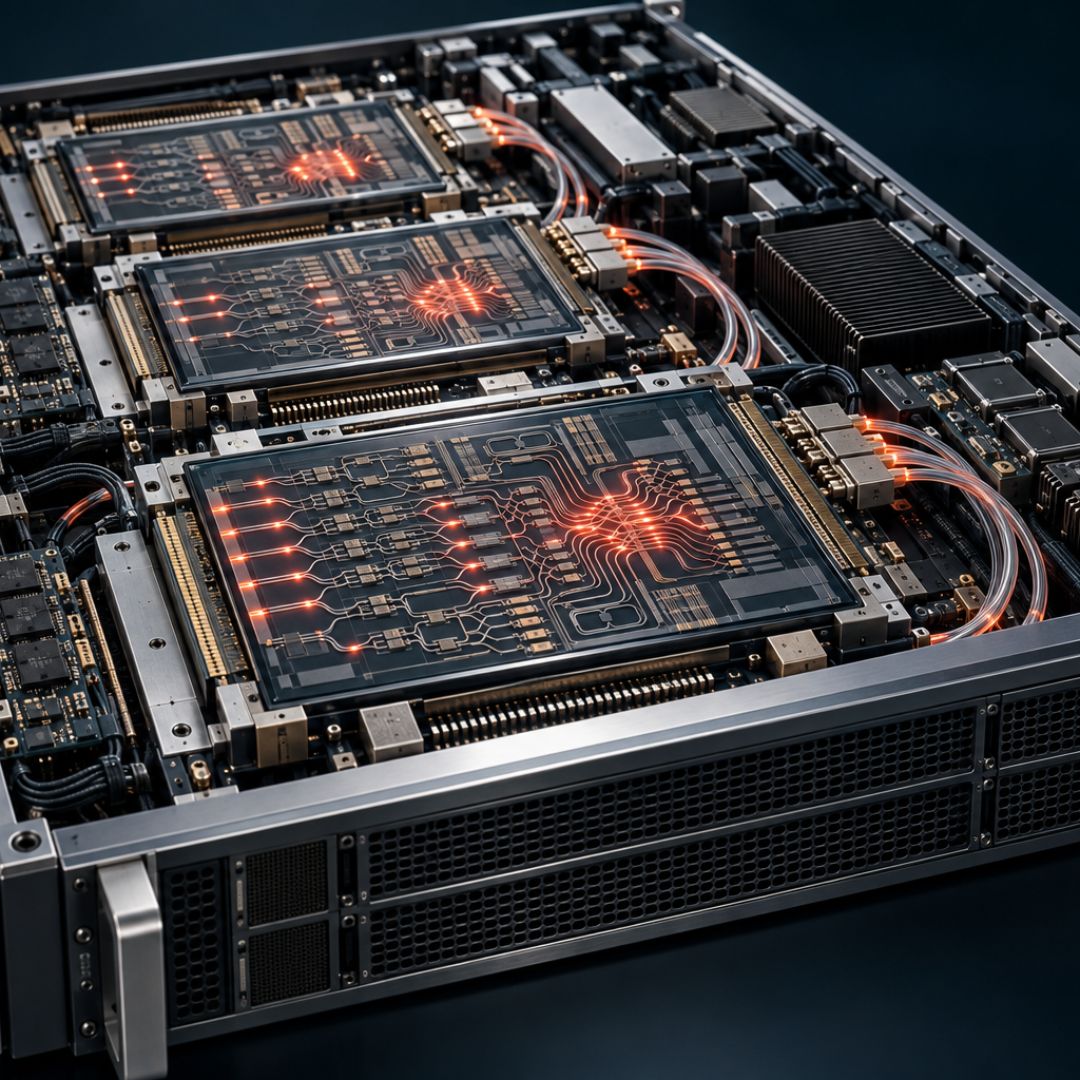
In today’s rapidly evolving digital landscape, the rise of General Artificial Intelligence (AI) is driving an unprecedented demand for high-bandwidth, low-latency links. The energy required to move data around is outgrowing that of compute, effectively limiting the growth of infrastructure that is required to develop next-generation AI models.
External Laser Sources for AI Data Centres
AI clusters rely on lasers to move data between tens of thousands of GPUs. However, the InP (Indium Phosphide) lasers used in current optical modules are showing their limits. They need constant cooling, require costly isolators, and fail too often, causing downtime that interrupts AI training runs.
O-band Photonic Switch
As cloud services, streaming, and AI workloads continue to proliferate at an alarming speed, electronic switches are becoming problematic as they consume enormous amounts of energy and can introduce delays and bottlenecks.
Quantum Key Distribution
Today’s network challenge lies in ensuring security against eavesdropping. Tomorrow’s challenge arises from new computing paradigms such as artificial intelligence and quantum computing, which may be able to break the encryption protecting online banking, government communications, and other critical digital infrastructure, creating a major security risk.
Photonic Quantum Computing
Classical computing is reaching its limits. But quantum computing is on the brink of revolutionising a variety of industries and applications, from personalised medicine and faster drug discovery in healthcare, to route optimisation in logistics. However, most competing quantum platforms require cryogenics and face scaling barriers.