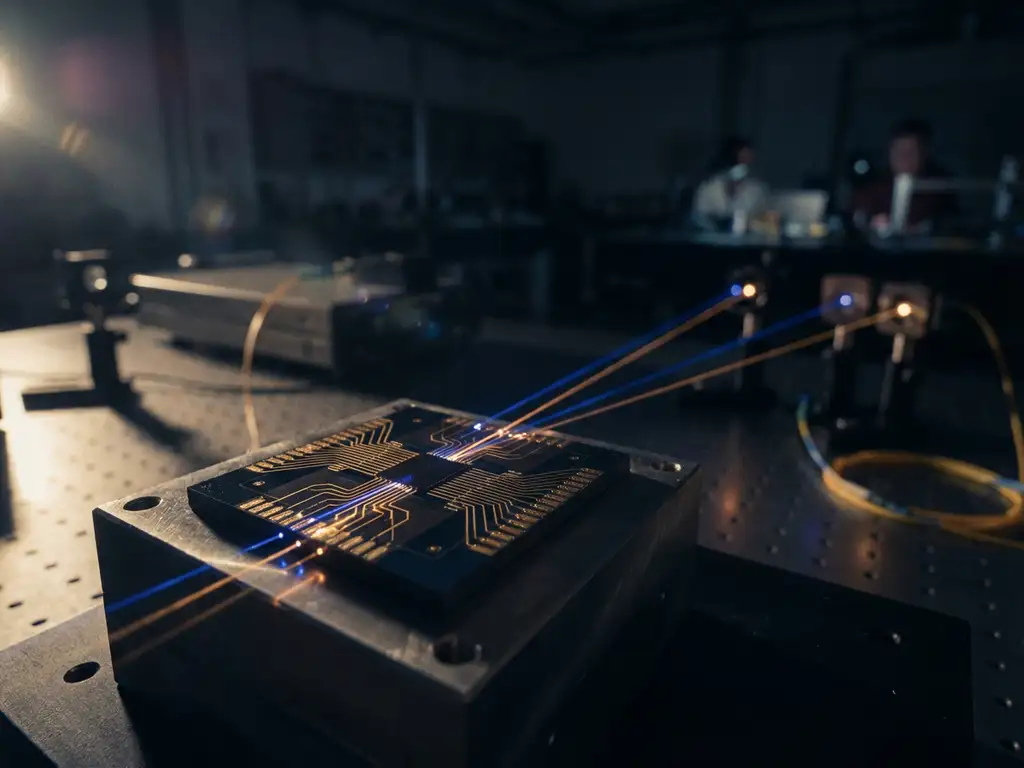
Photonic chip communication distances vary significantly depending on application requirements and transmission environments. While photonic chips excel at high-speed data transfer with reduced power consumption, understanding their distance capabilities is crucial for organizations evaluating integrated photonics for their communication infrastructure.
The maximum distance for photonic chip communication depends on several factors, including the transmission medium, signal power, wavelength, and application requirements. From short-range data center connections to long-haul telecommunications, photonic chip technology enables communication across vastly different distance scales.
What is the maximum distance for photonic chip communication?
Photonic chips can enable communication distances ranging from micrometers on-chip to thousands of kilometers in fiber-optic networks. The maximum distance depends on the specific application: short-range optical transceivers typically reach 2–10 kilometers, while long-haul telecommunications systems can span intercontinental distances exceeding 1,000 kilometers with optical amplification.
The distance capabilities of photonic chip technology vary dramatically across implementation scenarios. For on-chip communication within Photonic Integrated Circuits (PICs), signals travel only micrometers between components while maintaining high-speed data transmission with minimal signal loss and interference.
In data center applications, photonic chips enable high-speed optical transceivers for both short- and long-range optical communication. These systems typically support distances from 100 meters for intra-rack connections up to 10 kilometers for campus-wide data center interconnects. The compact, scalable design of photonic chips makes them ideal for these applications, where integrating multiple optical components on a single chip reduces system complexity.
For telecommunications networks, photonic chips serve as critical components in systems that transmit data across vast distances. When integrated into fiber-optic communication systems with optical amplifiers and repeaters, these chips enable transcontinental communication spanning thousands of kilometers while maintaining energy efficiency and signal integrity.
How does transmission distance vary between different photonic chip applications?
Transmission distances for photonic chip applications range from nanometer-scale on-chip connections to kilometer-scale network communications. Data center applications typically achieve 2–10 kilometers, automotive LiDAR systems operate within 200–300 meters, and telecommunications applications can extend to thousands of kilometers with the proper infrastructure.
In data and telecommunications applications, photonic chips address the challenge of accommodating exponential growth in global data traffic while maintaining energy efficiency. Short-range applications within data centers typically operate over distances of 100 meters to 2 kilometers, connecting servers and switches with high-speed data transmission capabilities that traditional electronic systems cannot match.
Automotive applications present entirely different distance requirements. LiDAR-on-chip solutions for autonomous driving create precise 3D maps of a vehicle’s surroundings in real time, typically operating within a range of 50 to 300 meters. These compact, lightweight systems can be mass-produced at lower cost than traditional LiDAR systems, making them scalable to high volumes for the automotive industry.
Medical and healthcare applications often require much shorter transmission distances but extremely high precision. Photonic biosensors and lab-on-a-chip platforms operate over microscopic distances, enabling portable diagnostic instruments that provide faster diagnoses at lower cost. These systems demonstrate how photonic chip technology adapts to application-specific distance requirements while maintaining superior performance characteristics.
What factors limit the maximum communication distance in photonic chips?
Key factors limiting photonic chip communication distance include signal attenuation, dispersion effects, noise accumulation, and power-budget constraints. Material properties of the transmission medium, wavelength selection, and available optical power determine the practical maximum distance before signal regeneration or amplification becomes necessary.
Signal attenuation is the primary distance limitation in photonic communication systems. As light travels through optical waveguides or fibers, it gradually loses intensity due to absorption and scattering. Different materials used in photonic chip platforms exhibit varying attenuation characteristics. Silicon nitride platforms offer low-propagation-loss waveguides, while indium phosphide systems may experience higher propagation losses that limit transmission distances.
Dispersion effects become increasingly problematic over longer distances, causing signal pulses to broaden and potentially overlap. This phenomenon limits the maximum achievable combination of data rate and transmission distance. Wavelength choice and waveguide design significantly affect dispersion characteristics, requiring careful optimization for specific distance requirements.
Power-budget constraints also play a crucial role in determining maximum communication distances. Available optical power must exceed the sum of all losses in the transmission path, including coupling losses, propagation losses, and receiver sensitivity requirements. This fundamental limitation often determines whether additional optical amplification or signal regeneration is necessary for longer-distance applications.
How do photonic chips compare to electronic chips for long-distance communication?
Photonic chips significantly outperform electronic chips for long-distance communication by offering lower signal loss, higher bandwidth, and immunity to electromagnetic interference. While electronic signals degrade rapidly over distance and require frequent regeneration, photonic chips enable transmission over much greater distances while maintaining signal integrity and consuming less power.
The fundamental advantage of photonic chips lies in their use of photons rather than electrons for information transfer. This approach enables high-speed data transmission with substantially lower power consumption than electronic alternatives. As global data traffic doubles every three to five years, photonic chips provide an energy-efficient solution to accommodate this growth sustainably.
Electronic chips face significant challenges in long-distance communication due to signal degradation, electromagnetic interference, and power consumption. Electronic signals require frequent amplification and regeneration over long distances, increasing system complexity and energy use. In contrast, photonic chips maintain signal quality over much greater distances, reducing the need for intermediate processing and lowering overall system costs.
The PhotonDelta ecosystem demonstrates how integrated photonics serves as a key enabling technology for next-generation communication systems. By combining multiple optical components on a single chip, these systems achieve performance levels that electronic alternatives cannot match while supporting the scaling and industrialization necessary for widespread adoption across telecommunications and data center applications.
As photonic chips continue to advance, understanding their distance capabilities becomes essential for organizations planning their communication infrastructure. Whether you’re exploring applications in data centers, telecommunications, or emerging technologies like autonomous vehicles, the versatility of photonic solutions offers compelling advantages across diverse distance requirements. The continued development of specialized human capital and strategic funding initiatives will accelerate innovation in this field, while growing ecosystem collaboration and internationalization efforts ensure that photonic communication technologies reach their full potential across global markets.