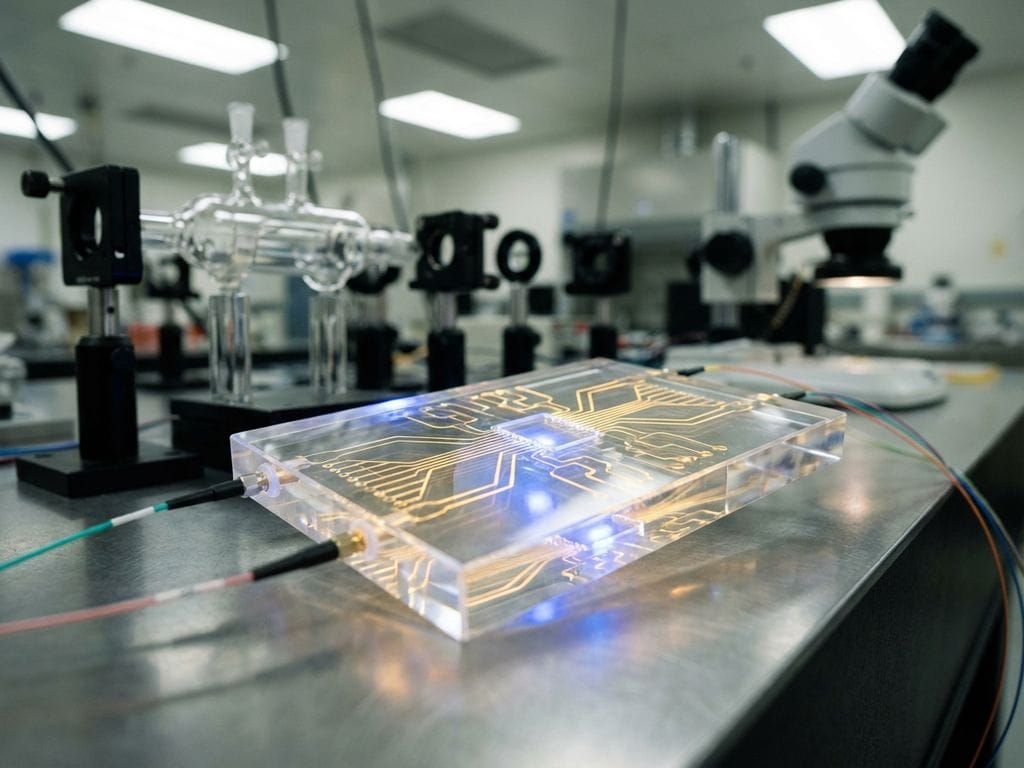
Photonic chips represent the next frontier in semiconductor technology, using light instead of electrons to process and transmit data. By 2026, the industry will reach critical manufacturing maturity, with pilot production facilities coming online and costs becoming commercially viable. This convergence of technological advancement and market readiness positions 2026 as the breakthrough year when photonic chips transition from specialized applications to mainstream adoption across multiple industries.
What are photonic chips and why will 2026 be a breakthrough year?
Photonic chips, also known as photonic integrated circuits (PICs), are semiconductor devices that use photons (light particles) instead of electrons to process and transmit information. These chips combine multiple photonic functions on a single device, enabling faster data processing, reduced power consumption, and enhanced sensing capabilities compared to traditional electronic chips.
The year 2026 represents a pivotal moment because several critical factors are converging simultaneously. Manufacturing processes that have been in development for decades are finally reaching industrial-scale production readiness. The industry has built comprehensive supply chains spanning design services, packaging, and testing capabilities, particularly in Europe, where integrated photonics value-chain development has been most advanced.
Commercial viability becomes realistic in 2026 as production volumes increase and costs decrease through automated wafer-scale manufacturing. The three core platforms—indium phosphide (InP), silicon nitride (SiN), and silicon photonics (SiPh)—will have matured enough to support diverse applications while maintaining the reliability standards required for mass-market adoption.
Market demand is also reaching a tipping point. The expansion of 5G networks, growth in artificial intelligence applications, and the push toward autonomous vehicles create urgent needs that electronic chips alone cannot sustainably meet. This demand pressure, combined with manufacturing readiness, creates the perfect conditions for widespread photonic chip deployment.
Which industries will photonic chips transform most dramatically by 2026?
Five key industries will experience the most significant transformation: data centers and telecommunications, automotive, healthcare, quantum computing, and sustainable agriculture. These sectors face challenges that photonic chips are uniquely positioned to solve through their superior speed, energy efficiency, and sensing capabilities.
Data centers and telecommunications will see the most immediate impact. Photonic chips enable high-speed optical transceivers that can handle massive data-consumption growth while reducing power requirements. The European Union’s €2 billion investment in data processing infrastructure specifically recognizes the strategic importance of this technology for economic competitiveness.
The automotive industry will benefit dramatically through affordable LiDAR solutions for autonomous driving. Traditional LiDAR systems are expensive and bulky, but photonic chip-based solutions are compact, lightweight, and can be mass-produced at significantly lower cost. This technology makes autonomous vehicle sensors commercially viable for widespread deployment.
Healthcare transformation centers on point-of-care diagnostics. Photonic biosensors enable accurate, affordable diagnostic instruments that can function outside traditional laboratory settings. This addresses the global need for decentralized healthcare, particularly important given recent events highlighting healthcare supply-chain vulnerabilities.
Quantum computing applications will leverage photonic chips for quantum communication and processing elements. The inherent properties of light make photonic systems ideal for maintaining quantum states and enabling secure communication networks.
Sustainable agriculture will utilize photonic sensing for precision farming. These systems enable real-time monitoring of crop conditions, soil quality, and environmental factors with unprecedented accuracy and low power consumption, supporting the goal of feeding 10 billion people by 2050 while minimizing environmental impact.
How will photonic chip manufacturing change in the next two years?
Manufacturing will transition from research-scale production to industrial-scale fabrication as pilot production facilities become operational and multi-platform foundries establish comprehensive capabilities. This shift represents the most significant change in photonic chip accessibility and commercial viability.
Pilot production facilities for all three core platforms—InP, SiN, and SiPh—will come online by 2026. These facilities bridge the gap between laboratory prototyping and full commercial production, allowing companies to test applications at meaningful scales while refining manufacturing processes. The European ecosystem has been developing this infrastructure with substantial public and private investment.
Cost-reduction strategies will become more sophisticated through multi-project wafer (MPW) runs, where several user products are fabricated on the same wafer. This approach keeps costs low while simplifying design requirements, making photonic chip technology accessible to smaller companies and to new applications that previously could not justify the investment.
Yield improvements will result from better design libraries and standardized building blocks. The industry is developing comprehensive collections of tested, predefined components that reduce design costs and improve reliability. This standardization mirrors the semiconductor industry’s evolution and enables more predictable manufacturing outcomes.
Supply-chain development will encompass the entire value chain from design services to packaging and testing. European initiatives have focused on creating complete ecosystems rather than isolated capabilities, ensuring that companies can access all necessary services within a coordinated network of more than 300 partners spanning academia, startups, and established corporations.
Integration capabilities will advance significantly, particularly in combining photonic and electronic chips in hybrid modules. This integration addresses the reality that most applications require both optical and electronic processing, creating systems that leverage the strengths of each technology.
What challenges must the photonic chip industry overcome by 2026?
The industry faces four critical challenges: talent shortages, standardization requirements, integration complexity, and technical scalability hurdles. Addressing these obstacles is essential for achieving the widespread adoption that 2026 promises to deliver.
Talent shortages represent the most pressing challenge. The integrated photonics industry requires specialists who understand both optical physics and semiconductor manufacturing—a rare combination. Educational programs and partnerships with leading universities are being developed to address this skills gap, but building sufficient expertise takes time. The industry needs engineers, technicians, and researchers who can work across the entire value chain.
Standardization needs are becoming urgent as the market matures. Unlike the semiconductor industry, which benefited from early standardization that enabled efficient integrated circuits and reduced prototyping cycles, photonic chips still lack comprehensive industry standards. Developing these standards while maintaining innovation flexibility requires careful coordination among manufacturers, customers, and research institutions.
Integration complexities arise because most applications require combining multiple platforms or integrating photonic and electronic components. Front-end integration during manufacturing versus back-end integration during packaging each presents different technical challenges. The industry must develop reliable, cost-effective integration techniques that maintain performance while enabling mass production.
Technical scalability hurdles include maintaining performance consistency across different production volumes and ensuring that laboratory successes translate to industrial-scale manufacturing. Quality control, testing methodologies, and packaging solutions must all scale effectively while preserving the precision and reliability that photonic applications demand.
Market-development challenges also persist, as many potential customers are still learning about photonic chip capabilities and how to integrate them into existing systems. The industry must balance education efforts with continued technical development to ensure that market demand grows alongside manufacturing capacity.
The photonic chip industry stands at a transformative moment. By 2026, the convergence of manufacturing maturity, market demand, and technical capability will establish integrated photonics as a key enabling technology across multiple sectors. As the industry navigates these critical developments, understanding the broader photonic chips landscape becomes essential for stakeholders seeking to capitalize on emerging opportunities. The collaborative nature of this transformation is evident in the thriving ecosystem that connects researchers, manufacturers, and end-users across the value chain. Addressing the talent shortage remains paramount, making strategic investments in human capital development crucial for sustained growth. Meanwhile, securing adequate funding for pilot production facilities and R&D initiatives will determine which regions lead the photonic revolution. The global nature of this opportunity also highlights the importance of internationalisation strategies that foster knowledge exchange and market access across borders. Success in the next two years will ultimately depend on how effectively the industry coordinates these interconnected elements while maintaining the innovation momentum that has brought photonic chips to this breakthrough point.