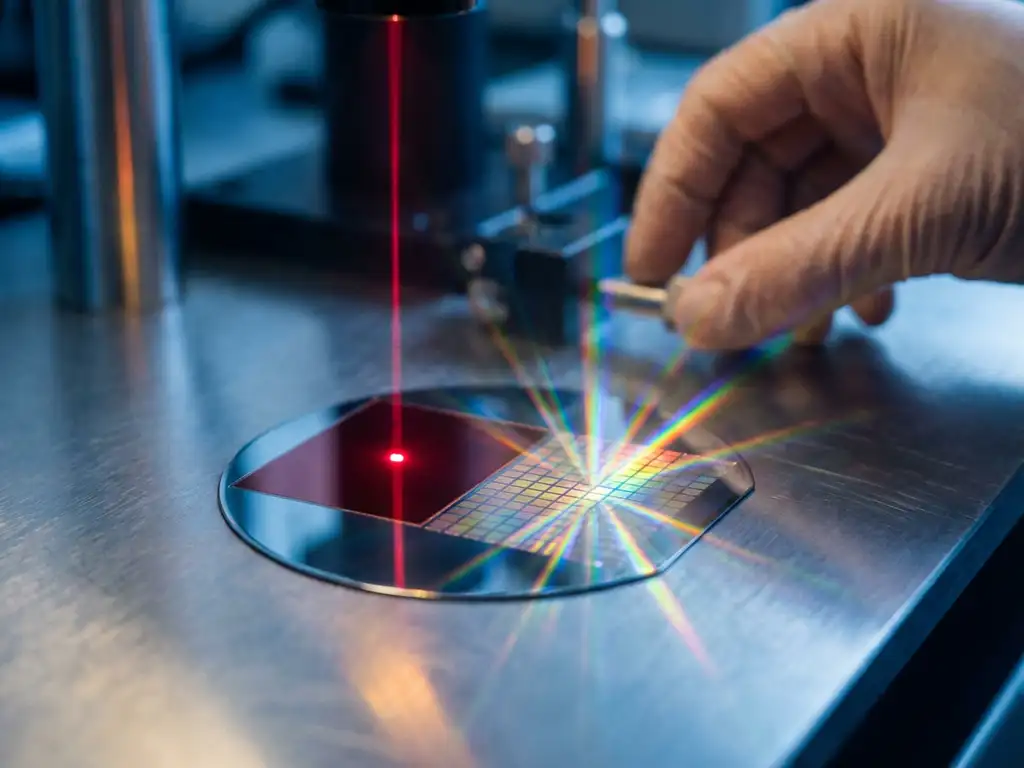
Photonic chips represent a transformative shift in how we process and transmit information. By using photons instead of electrons, they enable faster, more energy-efficient solutions. Within integrated photonics, these advanced semiconductors fall into two distinct categories based on how they handle optical signals: coherent and incoherent photonic chips.
Understanding the fundamental differences between these two approaches is essential for businesses and engineers evaluating photonic chip technology for telecommunications, sensing, and computing applications. Each type offers unique advantages depending on the specific requirements of the application and the overall system architecture.
What is the difference between coherent and incoherent photonic chips?
Coherent photonic chips preserve the phase relationship between light signals, enabling advanced signal processing and modulation techniques. Incoherent photonic chips, by contrast, process light without maintaining phase coherence and focus primarily on intensity-based operations. This fundamental distinction affects their performance characteristics, applications, and complexity.
Coherent systems maintain precise control over the optical phase, amplitude, and frequency of light signals. This capability allows them to implement sophisticated modulation formats such as quadrature amplitude modulation (QAM) and enables advanced functionalities such as optical signal processing and interference-based measurements. The coherent approach requires more complex components, including local oscillators and phase-locked loops, but delivers superior performance for demanding applications.
Incoherent photonic chips, by contrast, work with the intensity or power of light signals rather than their phase relationships. These systems are simpler to design and manufacture, making them more cost-effective for applications in which phase information is not critical. They excel in direct-detection scenarios, intensity-based sensing, and applications requiring straightforward on-off keying modulation.
The choice between coherent and incoherent approaches depends on factors such as transmission distance, data rates, signal-quality requirements, and cost constraints. Coherent systems typically dominate long-haul telecommunications and other high-performance applications, while incoherent solutions are well suited to shorter-distance communications and cost-sensitive deployments.
How do coherent photonic chips work?
Coherent photonic chips operate by maintaining precise phase relationships between optical signals throughout the processing chain, using local oscillators and advanced signal processing to encode, transmit, and decode information in both the amplitude and phase domains simultaneously.
The core principle involves generating a stable reference signal using an on-chip laser or local oscillator that maintains a fixed phase relationship with the incoming data signals. This reference enables the system to perform coherent detection, in which the signal and local oscillator are combined in photodetectors to extract amplitude, phase, and frequency information.
Key components in coherent photonic chips include tunable lasers, optical modulators, coherent receivers, and digital signal processing units. The modulators encode data by manipulating both the amplitude and phase of the optical carrier, enabling complex modulation formats that can carry multiple bits per symbol. This approach significantly increases spectral efficiency compared with simple intensity modulation.
Advanced coherent systems implement polarization multiplexing, in which data is encoded on both orthogonal polarization states of light, effectively doubling transmission capacity. The coherent receiver uses polarization beam splitters and balanced photodetectors to separate and detect these multiplexed signals, while digital signal processing algorithms compensate for transmission impairments and recover the original data.
What are the main applications of incoherent photonic chips?
Incoherent photonic chips are used primarily in direct-detection systems, short-reach communications, biosensing applications, and optical switching networks where phase information is not required and cost-effectiveness is prioritized over maximum performance.
In data center interconnects and short-range optical communications, incoherent systems provide reliable, high-speed connectivity using simple intensity modulation and direct detection. These applications benefit from the lower complexity and reduced power consumption of incoherent approaches while meeting bandwidth requirements over distances of up to several kilometers.
Biosensing is a major application area in which incoherent photonic chips enable lab-on-a-chip platforms for medical diagnostics. These systems detect changes in optical intensity, absorption, or fluorescence to identify biological markers, pathogens, or chemical compounds. The simpler architecture makes these sensors better suited to portable, point-of-care diagnostic devices that require affordability and ease of use.
Industrial sensing applications leverage incoherent photonic chips for environmental monitoring, process control, and safety systems. These include gas-detection sensors, temperature-monitoring systems, and optical switches that rely on intensity-based measurements rather than phase-sensitive detection.
Consumer electronics and automotive applications also benefit from incoherent photonic technologies, particularly in LiDAR systems for autonomous vehicles and optical components for augmented reality devices, where the focus is on reliable performance at competitive cost.
Which is better for telecommunications: coherent or incoherent photonic chips?
Coherent photonic chips are better suited to long-haul telecommunications and high-capacity networks because they can achieve higher spectral efficiency, longer transmission distances, and better signal quality. Incoherent chips excel in short-reach applications where cost and simplicity are priorities.
For submarine cables, metro networks, and long-distance terrestrial links, coherent systems dominate because they can compensate for chromatic dispersion, polarization-mode dispersion, and nonlinear effects that accumulate over hundreds or thousands of kilometers. The advanced modulation formats enabled by coherent detection support data rates of 400 Gbps and beyond on a single wavelength.
Coherent systems also provide superior receiver sensitivity, allowing signals to be detected at much lower power levels than in incoherent systems. This advantage translates into longer amplifier spacing, reduced system complexity, and improved overall network economics for high-capacity, long-distance applications.
However, incoherent solutions remain preferred for data center interconnects, access networks, and enterprise applications where transmission distances are limited to a few kilometers. These applications benefit from the lower cost, reduced power consumption, and simpler implementation of incoherent systems while still achieving the required performance levels.
The telecommunications industry increasingly uses a hybrid approach, deploying coherent technology for backbone networks and long-haul connections while implementing incoherent solutions for last-mile access and short-reach applications. This strategy optimizes both performance and cost across different network segments.
What are the cost differences between coherent and incoherent photonic technologies?
Coherent photonic chips typically cost three to five times more than incoherent alternatives because of their complex components, advanced manufacturing requirements, and sophisticated digital signal processing. Incoherent systems, by contrast, offer a lower total cost of ownership for applications that do not require maximum performance.
The higher cost of coherent systems stems from several factors, including the need for high-performance tunable lasers, precision optical components, and complex electronic circuits for digital signal processing. Manufacturing tolerances are tighter, and testing procedures are more extensive, contributing to increased production costs.
Packaging is another significant cost factor, as coherent systems require more sophisticated thermal management, electromagnetic shielding, and precise alignment of optical components. The integration of electronic and photonic functions also demands advanced packaging technologies that increase overall system costs.
However, cost analysis should consider total system economics rather than component costs alone. Coherent systems can transmit more data over longer distances without regeneration, potentially reducing the total number of components needed in a network. For high-capacity applications, the cost per bit transmitted may favor coherent solutions despite higher initial costs.
The PhotonDelta ecosystem supports both coherent and incoherent photonic chip development through its integrated photonics value chain, helping companies evaluate the most cost-effective approach for their specific applications. As manufacturing scales and the technology matures, the cost gap between coherent and incoherent solutions continues to narrow, making coherent technology accessible to a broader range of applications.
As the photonic chips market continues to mature, the distinction between coherent and incoherent technologies becomes increasingly important for strategic decision-making. Organizations looking to implement photonic solutions need to carefully assess their specific requirements alongside available resources and expertise. The thriving ecosystem surrounding integrated photonics offers numerous pathways for companies to explore these technologies, whether through partnerships, collaborative development, or direct implementation. Success in this field often depends on having access to specialized human capital who understand both the technical nuances and market applications of these advanced systems. For companies ready to take the next step, exploring funding opportunities and internationalisation strategies can help transform photonic innovations from concept to commercial reality.