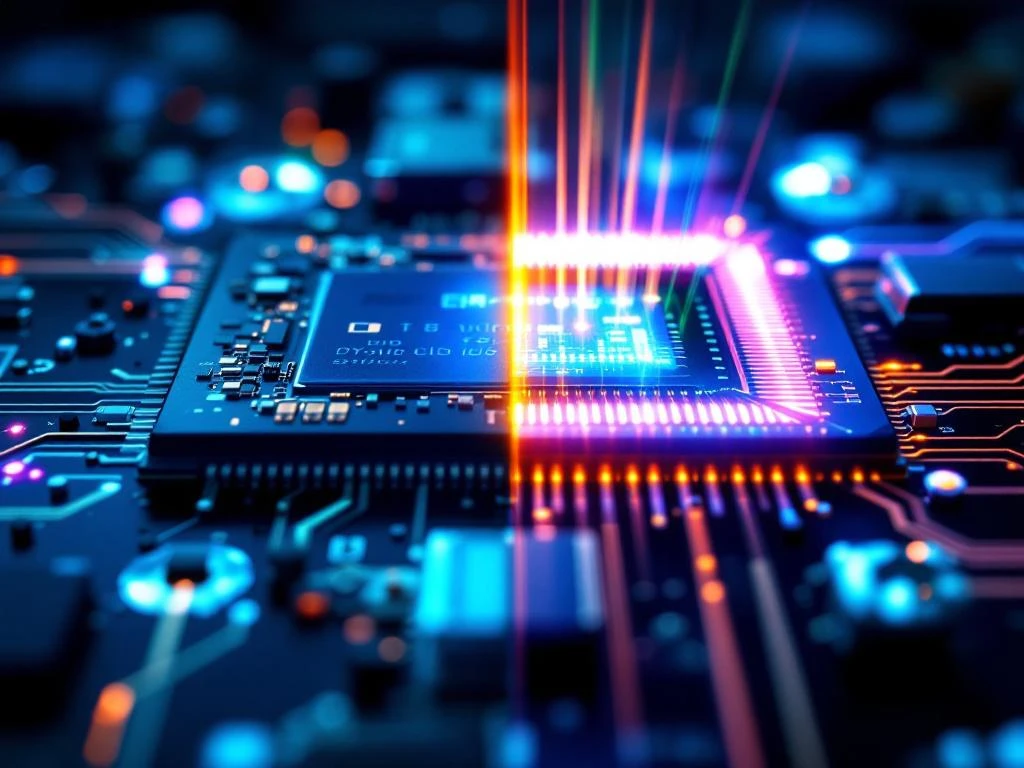
Photonic chips use light instead of electrons to process and transmit information, making them fundamentally different from traditional electronic chips. While electronic chips rely on electrical signals moving through silicon pathways, photonic chips manipulate photons (light particles) through specialized optical components. This light-based approach enables faster data transmission, lower power consumption, and reduced heat generation compared to conventional semiconductor technology.
What exactly are photonic chips and how do they work?
Photonic chips are semiconductor devices that use light particles (photons) instead of electrons to process, transmit, and manipulate information. These chips contain microscopic optical components such as waveguides, modulators, and detectors, fabricated on materials like indium phosphide (InP), silicon nitride (SiN), or silicon photonics (SiPh) platforms.
The fundamental working principle involves converting electrical signals into optical signals at the input, processing the light through various on-chip optical components, and then converting it back to electrical signals at the output when needed. Light travels through tiny waveguides etched into the chip material, similar to how electrons flow through wires in electronic circuits, but with significantly different properties.
Unlike traditional semiconductors that manipulate electron flow through doping and transistors, photonic chips control light using principles such as interference, refraction, and modulation. This allows them to perform complex operations like signal routing, amplification, and filtering entirely in the optical domain, reducing the need for multiple electrical-to-optical conversions that slow down conventional systems.
What’s the main difference between how photonic and electronic chips process information?
Electronic chips process information by controlling the flow of electrons through transistors and logic gates, while photonic chips manipulate light waves through optical components. Electronic signals travel at roughly one-third the speed of light due to material properties, whereas photonic signals travel at near light speed through optical waveguides.
The processing mechanisms differ fundamentally in their approach to data handling. Electronic chips use binary switching—transistors turn on or off to represent 1s and 0s. Photonic chips can encode information in multiple properties of light simultaneously, including wavelength, phase, amplitude, and polarization, enabling much higher data density.
Electronic chips face increasing challenges with heat generation and power consumption as they scale down to smaller transistor sizes. Each switching operation generates heat and consumes power. Photonic chips avoid many of these limitations because photons do not interact with each other or generate heat in the same way electrons do, allowing for more efficient parallel processing of multiple data streams.
The signal integrity also differs significantly. Electronic signals degrade over distance due to resistance and electromagnetic interference, requiring amplification and error correction. Optical signals in photonic chips maintain their quality over much longer distances and can carry multiple wavelengths simultaneously without interference.
Why are photonic chips faster and more energy-efficient than electronic chips?
Photonic chips achieve superior speed because light travels faster than electrical signals and can carry multiple data streams simultaneously using different wavelengths. They consume less energy because photons do not generate heat when traveling through waveguides, unlike electrons that create resistive heating in electronic circuits.
The speed advantage comes from parallel processing capabilities that electronic chips cannot match. A single photonic chip can handle dozens of different wavelengths simultaneously, each carrying separate data streams. This wavelength-division multiplexing allows one photonic circuit to do the work of multiple electronic circuits operating in parallel.
Energy-efficiency improvements stem from reducing the constant electrical-to-optical conversions required in traditional systems. In data centers, for example, electronic chips must convert electrical signals to light for transmission, then back to electrical for processing, then to light again for the next transmission. Photonic chips can process signals while keeping them in optical form, dramatically reducing power consumption.
Heat generation poses a major limitation for electronic chips, requiring extensive cooling systems that consume additional power. Photonic chips generate minimal heat during operation, reducing cooling requirements and allowing for denser packaging of components without severe thermal-management concerns.
What applications work better with photonic chips than electronic chips?
Photonic chips excel in applications requiring high-speed data transmission, precise sensing, or long-distance communication. Key areas include telecommunications networks, data center interconnects, LiDAR systems for autonomous vehicles, medical diagnostics, and quantum-computing applications where optical processing provides fundamental advantages.
In telecommunications and data centers, photonic chips enable faster internet speeds and more efficient data processing. They can handle the massive bandwidth requirements of 5G networks and cloud-computing infrastructure while consuming significantly less power than electronic alternatives. The ability to process multiple wavelengths simultaneously makes them ideal for dense data transmission.
Automotive applications benefit enormously from photonic LiDAR systems. These sensors create detailed 3D maps of vehicle surroundings for autonomous driving. Photonic chips make LiDAR systems more compact, reliable, and cost-effective by eliminating moving parts while providing precise distance measurements and object-detection capabilities.
Medical and healthcare applications leverage photonic chips for point-of-care diagnostics and biosensing. They enable miniaturized devices that can detect biomarkers with high accuracy at low cost, supporting the growing decentralized healthcare market. The precision and sensitivity of optical sensing make them particularly valuable for early disease detection.
Food and agriculture sectors use photonic chips for precision sensing and monitoring directly in fields and farms. These applications require low-power, accurate sensors that can operate in challenging environmental conditions while providing real-time data for optimizing crop yields and resource usage.
What are the current limitations of photonic chips compared to electronic chips?
Photonic chips face challenges in manufacturing complexity, higher initial costs, and integration difficulties with existing electronic systems. They also require light sources and cannot perform all the logic operations that electronic chips handle efficiently, making them complementary to, rather than complete replacements for, electronic circuits.
Manufacturing complexity represents a significant hurdle because photonic chip fabrication requires precise control of optical properties and materials. The tolerances for optical components are often tighter than for electronic circuits, making production more challenging and expensive. Different applications require different platform materials (InP, SiN, or SiPh), each with specific manufacturing processes.
Integration challenges arise when combining photonic and electronic components. Most applications require hybrid systems that leverage both technologies, but packaging and connecting these different chip types adds complexity and cost. The industry is still developing standardized interfaces and integration techniques.
Cost considerations currently limit widespread adoption, particularly for consumer applications. While photonic chips offer superior performance for specific tasks, the manufacturing infrastructure and expertise required make them more expensive than mature electronic chip production. However, costs are expected to decrease as production volumes increase and manufacturing processes improve.
Market maturity also plays a role—the photonic chip industry is still developing standardized design libraries, process flows, and materials compared to the well-established electronic chip ecosystem. This makes prototyping and development more time-consuming and expensive for companies exploring photonic solutions.
The future of integrated photonics depends on continued innovation across multiple fronts, from advancing photonic chips technology to developing the skilled workforce needed to scale production. Success requires more than just technological breakthroughs—it demands a coordinated approach that includes strategic funding for research and development, comprehensive human capital development programs, and strong internationalisation efforts to connect global markets and expertise. Building this foundation through a collaborative ecosystem approach will ultimately determine how quickly photonic technologies can transition from promising research concepts to transformative commercial solutions that reshape industries from telecommunications to healthcare.