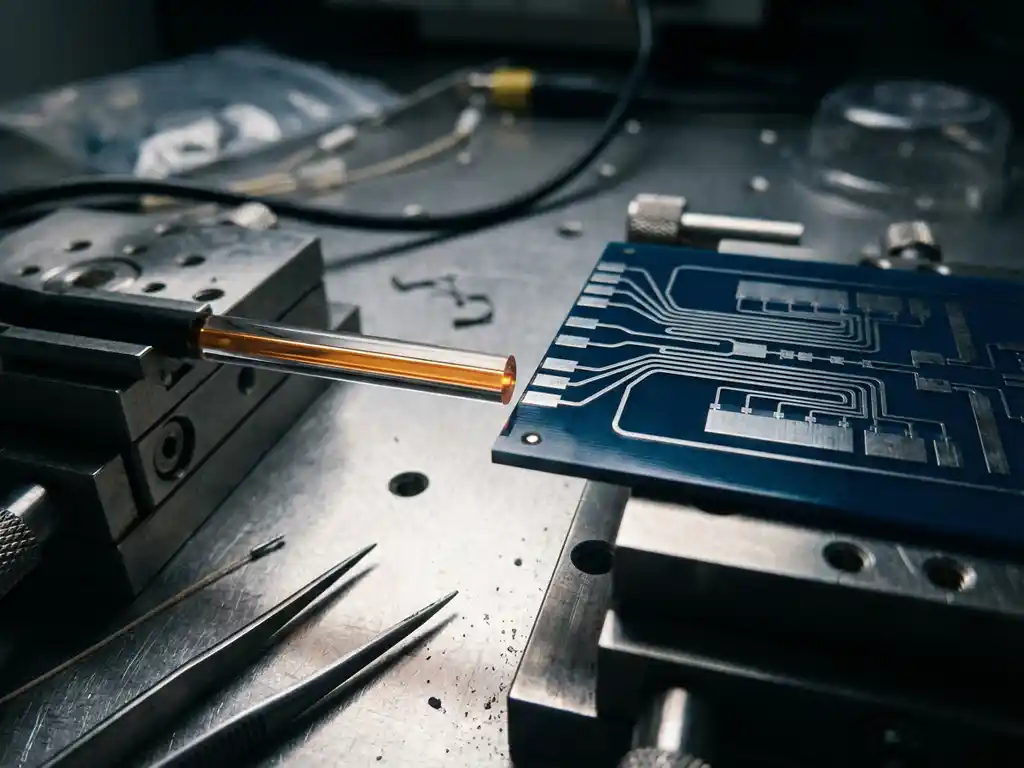
Connecting optical fibers to photonic chips requires precise alignment to achieve optimal performance in integrated photonics systems. This critical coupling process determines how effectively light transfers between fiber-optic cables and Photonic Integrated Circuits (PICs), directly impacting the functionality of everything from data center transceivers to advanced sensing applications.
As photonic chip technology becomes increasingly important for high-speed communications and sensing solutions, understanding the alignment techniques and equipment involved becomes essential for engineers working with these sophisticated optical systems.
What is optical fiber-to-photonic-chip alignment?
Optical fiber-to-photonic-chip alignment is the precise positioning process that couples light from optical fibers into the waveguides of Photonic Integrated Circuits (PICs). This process involves positioning the fiber core precisely relative to the chip’s optical input/output ports to maximize light transmission efficiency and minimize optical losses.
The alignment process requires positioning accuracy typically within submicron tolerances. Photonic chips contain waveguides that are only a few micrometers wide, while standard single-mode optical fibers have core diameters of approximately 9 micrometers. This size mismatch, combined with the need for precise angular alignment, makes the coupling process technically demanding.
Modern alignment systems use sophisticated positioning stages and optical monitoring equipment to achieve the required precision. The process often involves coarse positioning to bring the fiber and chip into approximate alignment, followed by fine-tuning adjustments while monitoring optical power transfer in real time.
Why is precise alignment so critical for photonic chips?
Precise alignment is critical because even small misalignments can cause significant optical power losses, reducing system performance and potentially making the photonic chip unusable. Lateral misalignments of just one micrometer can result in coupling losses exceeding 1 dB, while angular misalignments can be equally detrimental.
Poor alignment affects multiple aspects of photonic chip performance. Signal quality degrades when insufficient light couples into the chip’s waveguides, leading to reduced signal-to-noise ratios in communication applications. In sensing applications, misalignment can compromise measurement accuracy and sensitivity.
The economic impact of alignment precision cannot be overstated. Manufacturing costs increase significantly when alignment tolerances are not met, as chips may require rework or replacement. For high-volume applications in the integrated photonics value chain, consistent alignment processes are essential to achieving the cost targets necessary for widespread adoption.
What are the main methods for aligning optical fibers to photonic chips?
The main alignment methods include active alignment using real-time optical feedback, passive alignment using precision mechanical features, and hybrid approaches that combine both techniques. Active alignment offers the highest precision but requires more complex equipment, while passive methods enable faster, more cost-effective assembly.
Active alignment involves monitoring optical power transmission while adjusting fiber position using motorized stages. This method achieves the best coupling efficiency by optimizing alignment in real time, making it suitable for high-performance applications where maximum optical power transfer is essential.
Passive alignment relies on precision-manufactured mechanical features such as V-grooves, alignment pins, or molded connectors. These features guide the fiber and chip into predetermined positions without requiring optical feedback. While less precise than active methods, passive alignment enables automated assembly processes suitable for high-volume manufacturing.
Hybrid alignment approaches use passive features for coarse positioning followed by active fine-tuning. This combination balances alignment precision with manufacturing efficiency, making it attractive for scaling photonic chip technology to industrial volumes.
How does active alignment work in fiber-chip coupling?
Active alignment works by continuously monitoring optical power transmission while precision motorized stages adjust the fiber position along multiple axes until optimal coupling is achieved. The system uses photodetectors to measure transmitted light and feedback-control algorithms to maximize the optical signal.
The process typically begins with coarse positioning using vision systems or mechanical references to bring the fiber within the capture range of the fine-alignment stages. High-resolution motorized stages then make micro-adjustments in the X, Y, and Z directions, as well as in angular orientation, while monitoring optical power coupling efficiency.
Modern active alignment systems can achieve positioning accuracies better than 0.1 micrometers and angular precision within 0.01 degrees. The alignment algorithm typically uses optimization routines such as hill-climbing or gradient-descent methods to find the position that maximizes optical power transfer.
Once optimal alignment is achieved, the fiber position is permanently fixed using UV-curable adhesives, laser welding, or mechanical clamping. The entire active alignment process, while precise, can take several minutes per fiber connection, making it more suitable for lower-volume, high-performance applications.
What equipment is needed for optical fiber alignment?
Essential equipment includes precision motorized positioning stages, optical power meters or photodetectors, microscopy systems for visual guidance, and fixation tools such as UV-curing systems or laser welders. Additional equipment may include temperature controllers, vibration-isolation systems, and automated handling mechanisms for production environments.
Motorized positioning stages form the core of any alignment system, providing the precision movement necessary for accurate fiber positioning. These stages typically offer submicrometer resolution across multiple axes and must maintain stability throughout the alignment process. High-end systems may include piezoelectric actuators for the finest positioning adjustments.
Optical monitoring equipment measures light-coupling efficiency during alignment. This includes photodetectors, optical power meters, and sometimes optical spectrum analyzers for wavelength-specific applications. The monitoring system must have sufficient sensitivity and speed to provide real-time feedback to the positioning system.
Vision systems using high-resolution cameras and microscopes help with initial positioning and provide visual feedback during alignment. These systems often include automated pattern-recognition capabilities to identify alignment features on both the fiber and the photonic chip. For production environments, the PhotonDelta ecosystem includes suppliers that provide specialized alignment equipment designed to scale integrated photonics manufacturing to industrial volumes.
Mastering fiber-to-chip alignment techniques represents just one aspect of the broader journey toward scalable photonic integration. As the industry continues to mature, the development of skilled professionals becomes increasingly crucial to advancing these precision manufacturing processes. The success of photonic chips in commercial applications depends not only on technical breakthroughs but also on building the necessary human capital to support growing manufacturing demands. Organizations looking to enter this field will find that securing appropriate funding for equipment and training investments is essential for establishing competitive alignment capabilities. Meanwhile, the collaborative nature of the industry means that connecting with established partners within the broader ecosystem can provide valuable insights into best practices and emerging alignment technologies. As photonic integration continues its global expansion through internationalization efforts, the alignment techniques discussed here will undoubtedly evolve to meet the demands of increasingly sophisticated optical systems.