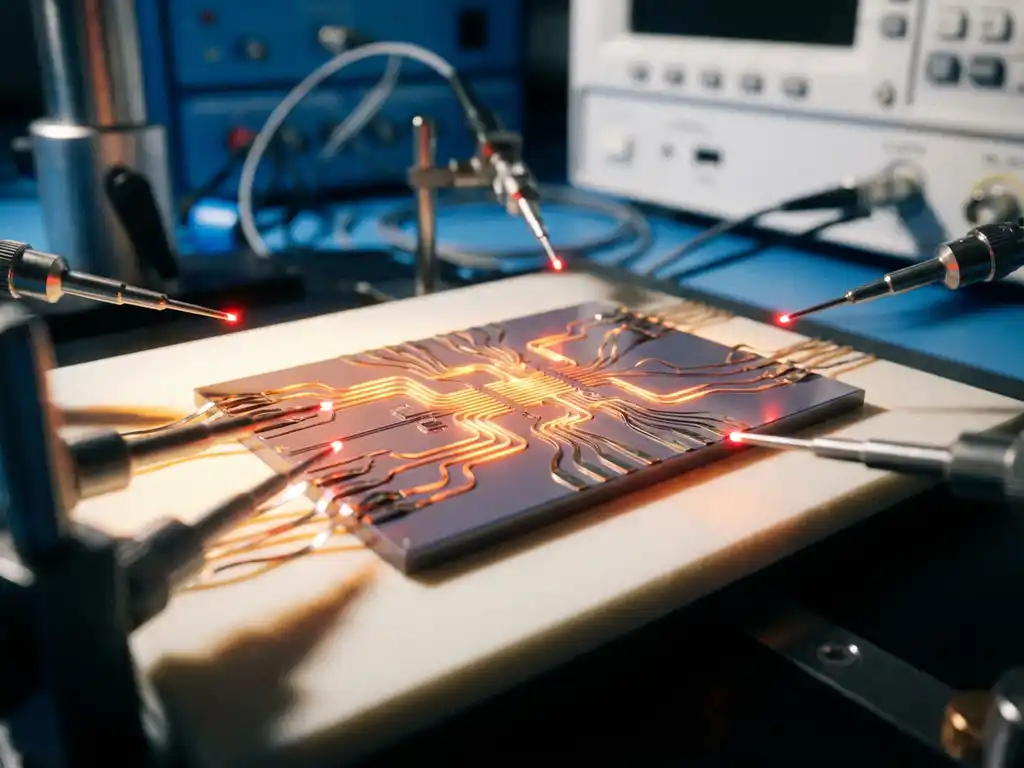
Thermal management represents one of the most critical challenges in photonic chip technology. While integrated photonics offers significant advantages over traditional electronic solutions, including lower power consumption and higher data transmission speeds, these advanced photonic integrated circuits (PICs) remain sensitive to temperature fluctuations that can dramatically impact their performance.
Understanding how heat affects photonic chips becomes increasingly important as the PhotonDelta ecosystem continues to scale and industrialize this key enabling technology. From data centers requiring consistent optical performance to automotive LiDAR systems operating in extreme environments, effective thermal management ensures reliable operation across the integrated photonics value chain.
What happens when photonic chips get too hot?
When photonic chips overheat, their optical performance degrades significantly, leading to wavelength drift, increased signal loss, and potentially permanent damage to integrated photonic components. Excessive heat causes the refractive index of waveguide materials to change, disrupting light propagation and compromising the chip’s functionality.
The most immediate consequence of overheating is wavelength instability. As temperatures rise, the optical properties of materials used in platforms such as silicon nitride (SiN) and indium phosphide (InP) shift, causing laser outputs to drift from their intended wavelengths. This wavelength drift can break communication links in data transmission applications or reduce accuracy in sensing applications.
Beyond performance degradation, sustained high temperatures can cause irreversible damage to photonic chips. The delicate structures within PICs, including waveguides, modulators, and photodetectors, may experience thermal stress that leads to material expansion, cracking, or complete component failure. This thermal damage often requires complete chip replacement rather than repair.
How does temperature affect optical performance in photonic chips?
Temperature changes directly alter the refractive index and physical dimensions of photonic materials, causing wavelength shifts, power variations, and timing delays in optical signals. Even small temperature fluctuations can significantly impact the precise optical characteristics that photonic integrated circuits depend on for proper operation.
The relationship between temperature and optical performance varies across different photonic platforms. Silicon photonics (SiPh) exhibits a relatively high thermo-optic coefficient, meaning its refractive index changes substantially with temperature. This sensitivity requires active thermal control in many applications to maintain stable operation.
Indium phosphide platforms show different thermal characteristics, particularly in the performance of active components such as lasers and amplifiers. Temperature increases can reduce laser efficiency, shift emission wavelengths, and increase the threshold currents required for operation. These changes directly impact overall system performance in applications ranging from optical transceivers to biosensing devices.
Silicon nitride platforms generally demonstrate better thermal stability than other materials, contributing to their popularity in applications requiring consistent performance across temperature ranges. However, even SiN-based PICs require careful thermal management in high-power or precision applications.
What are the main causes of overheating in photonic integrated circuits?
The primary causes of overheating in photonic chips include electrical power dissipation from active components, optical absorption losses, inadequate heat-dissipation pathways, and external environmental factors. High-power lasers, modulators, and electronic control circuits generate the most significant thermal loads within integrated photonic systems.
Active photonic components represent the largest source of heat generation. Semiconductor lasers, particularly those on InP platforms, convert electrical energy into optical energy with efficiency limitations that result in waste heat. Similarly, high-speed modulators and photodetectors contribute thermal loads during operation, especially in high-bandwidth data transmission applications.
Optical losses within the photonic circuit itself create additional heating. When light propagates through waveguides, bends, and coupling interfaces, some optical energy is converted to heat through absorption and scattering mechanisms. While modern photonic chip technology minimizes these losses, they still contribute to the overall thermal load in high-power applications.
Package-level thermal management also influences chip temperatures. Insufficient heat sinking, poor thermal interface materials, or inadequate airflow in system designs can prevent effective heat removal from PICs. The integration of photonic and electronic components in hybrid systems can create thermal hotspots that require careful design consideration.
How do engineers prevent photonic chips from overheating?
Engineers prevent photonic chip overheating through a combination of thermal design strategies, including active cooling systems, optimized heat sinking, temperature monitoring, and thermal compensation circuits. These approaches ensure stable operation across the wide temperature ranges required for commercial integrated photonics applications.
Passive thermal management forms the foundation of most cooling strategies. Engineers design chip packages with high-thermal-conductivity substrates and heat spreaders that efficiently conduct heat away from active regions. Materials such as aluminum nitride or copper provide excellent thermal pathways while maintaining electrical isolation where needed.
Active cooling systems become necessary for high-power photonic applications. Thermoelectric coolers (TECs) provide precise temperature control by actively pumping heat away from photonic chips. These systems can maintain chip temperatures within narrow ranges, ensuring consistent optical performance even as ambient conditions change.
Temperature compensation is another critical strategy. Engineers implement feedback control systems that monitor chip temperature and adjust operating parameters to maintain stable output characteristics. This approach is particularly valuable in laser systems, where wavelength stability directly impacts system performance.
Chip-level design optimization also contributes to thermal management. Engineers distribute heat-generating components across the chip area, implement thermal isolation between sensitive regions, and optimize power consumption to minimize overall thermal loads.
What’s the difference between thermal management in photonic versus electronic chips?
Thermal management in photonic chips requires more precise temperature control and addresses different heat sources than thermal management in electronic chips, because photonic systems are more sensitive to temperature-induced performance variations. While electronic chips primarily focus on preventing failure, photonic chips must maintain exact operating conditions for optimal optical performance.
Sensitivity levels differ significantly between these technologies. Electronic chips typically tolerate temperature variations of tens of degrees without major performance degradation, while photonic chips may require temperature stability within a few degrees—or even fractions of a degree—for precision applications such as wavelength-division multiplexing systems.
Heat-generation mechanisms also vary between photonic and electronic systems. Electronic chips generate heat primarily through resistive losses and switching activity, with heat distribution often correlating with logic density. Photonic chips generate heat through optical-to-electrical conversion inefficiencies and optical absorption, creating different thermal patterns that require specialized cooling approaches.
The consequences of thermal issues create another key distinction. Electronic chip overheating typically leads to logic errors, reduced switching speeds, or component failure. Photonic chip thermal problems manifest as wavelength drift, optical power variations, and signal quality degradation that can disrupt entire optical networks or sensing systems.
This thermal sensitivity underscores why strengthening Europe’s position in photonic chip technology requires advanced thermal management expertise. As the PhotonDelta ecosystem continues to develop manufacturing readiness for PICs across various platforms, thermal design capabilities become essential for the successful commercialization of integrated photonics solutions in demanding applications, from automotive sensing to data center communications.
As the industry continues to mature, mastering thermal management becomes increasingly vital for realizing the full potential of photonic chips across diverse applications. The collaborative nature of the photonic ecosystem enables companies to share thermal design expertise and best practices, accelerating innovation while reducing development risks. For organizations looking to enter this field, developing specialized human capital with thermal management expertise represents a strategic investment. The growing global demand for thermally robust photonic solutions also creates new opportunities for internationalization, particularly as companies seek to deploy photonic systems in challenging environments worldwide. Whether through collaborative research initiatives or targeted development programs, securing appropriate funding for thermal management research will ultimately determine which organizations successfully navigate the technical challenges ahead and establish themselves as leaders in this critical aspect of photonic chip design.