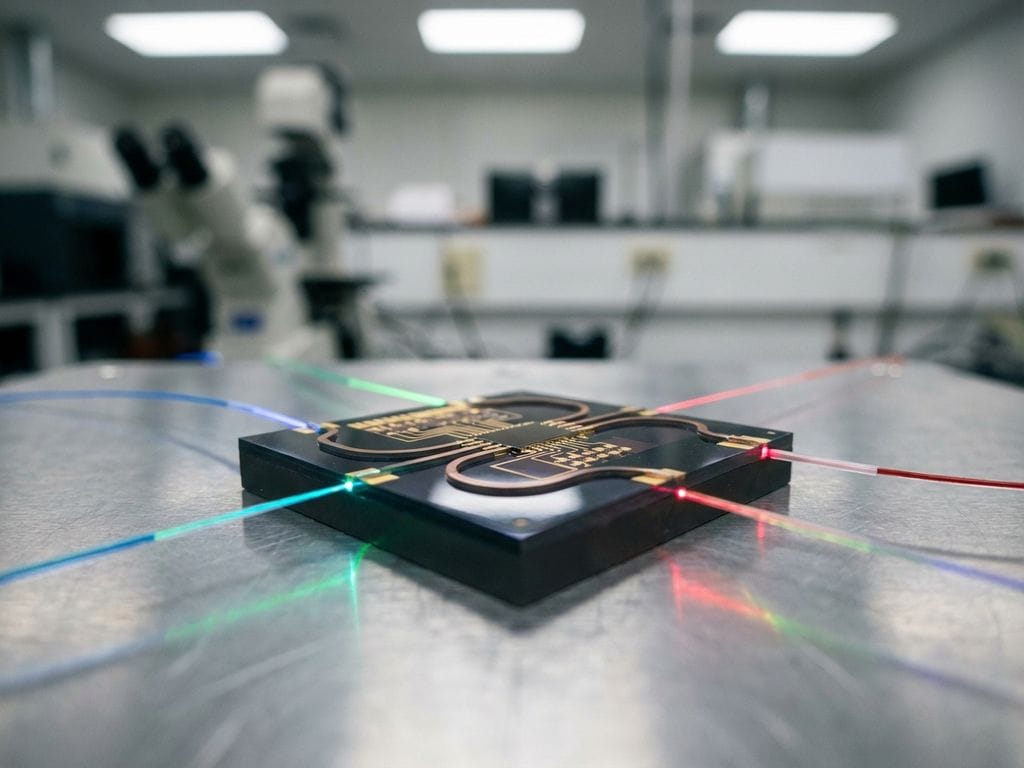
Photonic chips process information using light photons instead of electrons, enabling faster data transmission with lower power consumption and reduced heat generation. These advanced microchips integrate multiple optical components on a single substrate, creating powerful solutions for telecommunications, computing, and sensing applications.
What exactly is a photonic chip and how does it work?
Photonic chips, also known as photonic integrated circuits (PICs), are semiconductor devices that manipulate light photons to process, transmit, and control information rather than relying on electrical signals like traditional chips. These sophisticated devices integrate multiple optical components onto a single substrate, creating compact systems that harness the unique properties of light.
The fundamental principle behind photonic chips involves guiding light through microscopic waveguides etched into the chip substrate. These waveguides act like optical highways, directing photons along predetermined paths where they interact with various components. Key elements include modulators that encode information onto light beams, photodetectors that convert optical signals back to electrical ones, and optical amplifiers that boost signal strength.
Integrated photonics technology enables the creation of complex optical circuits by combining passive components (such as waveguides, splitters, and filters) with active elements (including lasers, modulators, and detectors) on platforms like indium phosphide (InP), silicon photonics (SiPh), or silicon nitride (SiN). Each platform offers distinct advantages: InP provides excellent light-generation capabilities, SiPh offers compatibility with existing semiconductor manufacturing, while SiN delivers low-loss waveguides ideal for sensing applications.
What are the main applications where photonic chips are used today?
Photonic chips currently serve critical roles in data communications, telecommunications infrastructure, autonomous vehicle systems, medical diagnostics, and quantum computing platforms, with each application leveraging light’s unique properties to solve specific technical challenges.
In data centers and telecommunications, photonic chips enable high-speed optical transceivers that handle the massive data volumes required by modern internet infrastructure. These chips convert electrical signals to optical ones for transmission through fiber-optic cables, then back to electrical signals at the receiving end, supporting data rates exceeding 400 gigabits per second.
The automotive industry relies on photonic chips for LiDAR systems in autonomous vehicles. These chips generate and process laser pulses that create detailed 3D maps of the vehicle’s surroundings, enabling precise distance measurements and object detection crucial for safe autonomous navigation.
Medical and biosensing applications use photonic chips to create miniaturized diagnostic devices capable of detecting biomarkers with high accuracy. These point-of-care platforms enable rapid testing for various health conditions, supporting the growing trend toward decentralized healthcare and home testing solutions.
Quantum computing systems incorporate photonic chips to generate, manipulate, and detect quantum states of light, enabling quantum information processing and secure communications. High-performance computing also benefits from photonic interconnects that reduce power consumption while increasing data transfer speeds between processors.
How do photonic chips compare to traditional electronic chips?
Photonic chips offer superior speed and bandwidth capabilities compared to electronic chips, with significantly lower power consumption and heat generation, though they require different manufacturing processes and integration approaches for optimal performance.
Speed represents the most significant advantage of photonic chips. While electronic signals travel at roughly one-third the speed of light through copper wires, photonic signals travel at nearly full light speed through optical waveguides. This fundamental difference enables photonic chips to process information much faster, particularly for applications requiring high-bandwidth data transmission.
Power efficiency strongly favors photonic solutions. Electronic chips generate substantial heat as electrons encounter resistance moving through conductors, requiring active cooling systems and consuming significant energy. Photonic chips experience minimal energy loss during light transmission, resulting in lower operating temperatures and reduced power requirements.
However, electronic chips maintain advantages in certain areas. They excel at logic operations, memory storage, and complex computational tasks that photonic chips cannot easily replicate. Electronic manufacturing processes are more mature and cost-effective, while photonic chip production requires specialized facilities and expertise.
Integration challenges differ between the technologies. Electronic chips can easily incorporate multiple functions on a single device, while photonic chips often require hybrid approaches combining optical and electronic components. This complexity affects both manufacturing costs and system design considerations.
What makes photonic chips faster and more efficient than electronic ones?
Photonic chips achieve superior performance because light photons travel faster than electrons, encounter no electrical resistance, and can carry multiple data streams simultaneously through wavelength-division multiplexing, resulting in dramatically higher bandwidth and lower energy consumption.
The speed advantage stems from fundamental physics. Light travels at approximately 300 million meters per second in a vacuum and nearly 200 million meters per second through optical waveguides. Electrons in copper conductors move much more slowly, typically at speeds representing only a small fraction of light speed, creating an inherent performance bottleneck in electronic systems.
Energy efficiency improvements arise from the absence of electrical resistance in optical transmission. When electrons flow through conductors, they collide with atoms and generate heat as waste energy. Photons experience no such resistance when traveling through optical waveguides, maintaining their energy throughout transmission and requiring minimal power to preserve signal integrity.
Bandwidth capabilities represent another crucial advantage. A single optical fiber or waveguide can simultaneously carry dozens of different wavelengths, each containing an independent data stream. This wavelength-division multiplexing enables massive parallel data transmission that is impossible with electronic conductors, which can carry only one signal at a time.
Heat-generation differences create cascading performance benefits. Electronic chips require substantial cooling systems that consume additional power and limit packaging density. Photonic chips generate minimal heat, enabling tighter integration and reducing overall system power requirements. This thermal advantage becomes increasingly important as data-processing demands continue to grow across industries requiring high-performance computing solutions.
As photonic technology continues to mature, the potential for even more groundbreaking applications becomes increasingly apparent. The journey from laboratory innovation to commercial implementation requires a robust ecosystem that brings together research institutions, manufacturers, and end-users. Organizations looking to explore photonic solutions will find that accessing the right funding opportunities and developing specialized human capital are essential steps in harnessing this technology’s transformative power. The ongoing internationalisation of photonic development ensures that innovations in this field will continue to accelerate, making now an exciting time to explore how photonic chips might revolutionize your industry or application.